
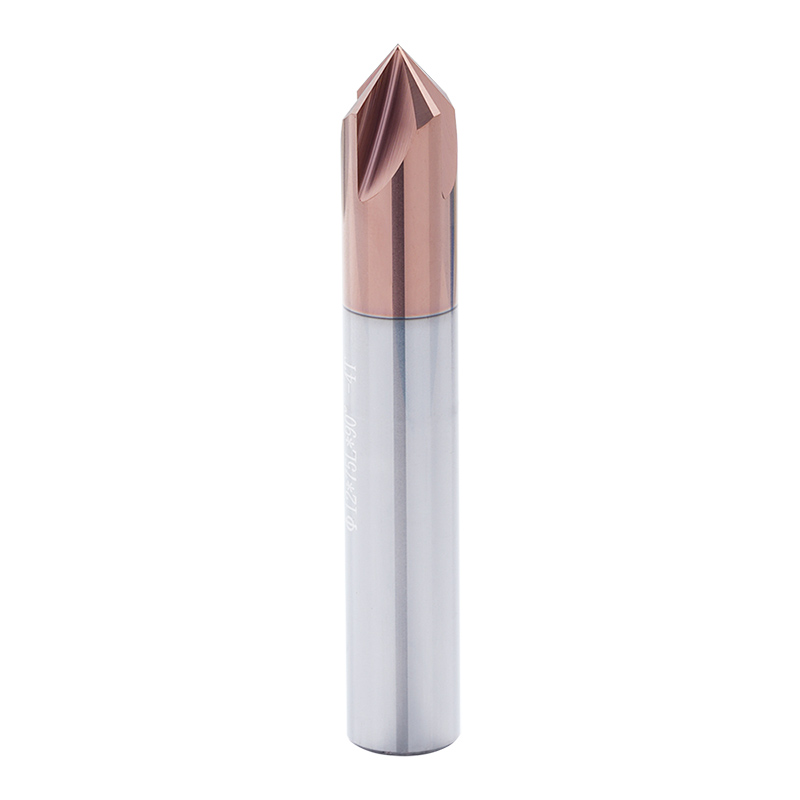


Product Overview:
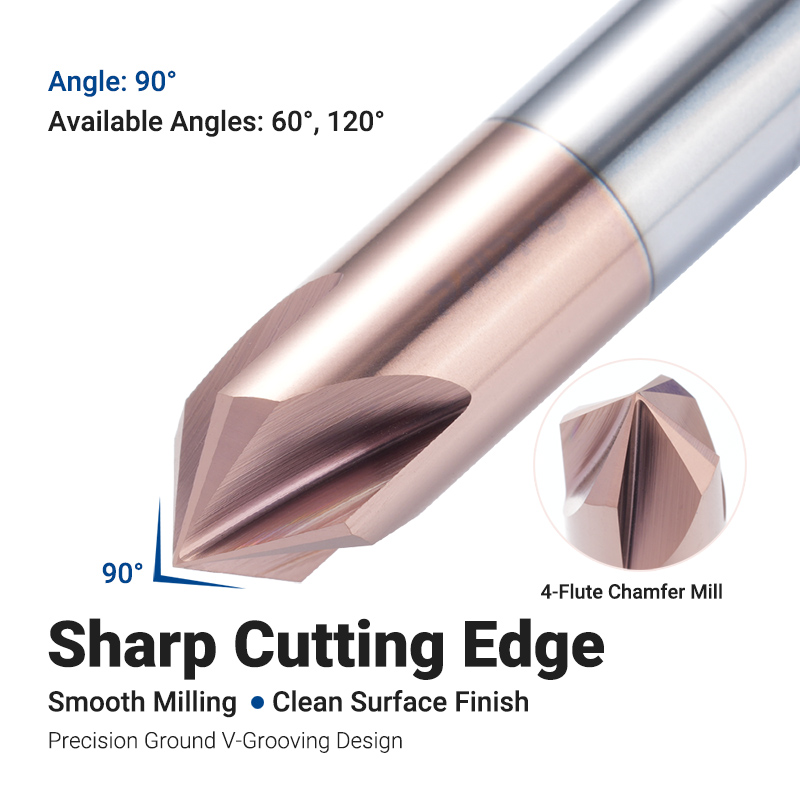
Our carbide chamfer mill combines sub-micron tungsten carbide with an advanced TiSiN nanocomposite coating rated for HRC55 hardness. In addition, the four-flute geometry equalizes cutting pressures during high-feed edge beveling and hole countersinking. As a result, this 4 flute chamfer mill delivers chatter-free finishes across carbon steel, alloy steel, and abrasive grey cast iron. Therefore, CNC machine operators choose this solid carbide chamfer mill to eliminate secondary hand deburring operations on production parts.
Product Features:
First, this carbide chamfer end mill features four precision-ground helical flutes that accelerate chip evacuation from confined chamfer grooves. In addition, the bronze TiSiN coating provides oxidation resistance up to 900°C under dry machining conditions. By contrast with single-flute tools, this 4 flute carbide chamfer mill distributes radial tool load across multiple cutting edges. Consequently, the reinforced cutting tip resists corner chipping during interrupted milling passes along component shoulders.
Applications and Machining Materials:
Specifically, workshops deploy this coated carbide chamfer mill in point angles including 60, 90, and 120 degrees across CNC machining centers and tapping centers. In addition, this tool profiles 45# carbon steel, 42CrMo alloy steel, and ductile iron casting housings reliably. Therefore, production managers standardize on this chamfering end mill line across automotive transmission manufacturing, mold base squaring, and hydraulic manifold machining at feed rates up to 0.05 mm/z.
4 Flute Thread Milling Cutter – Size & Angle Specifications:
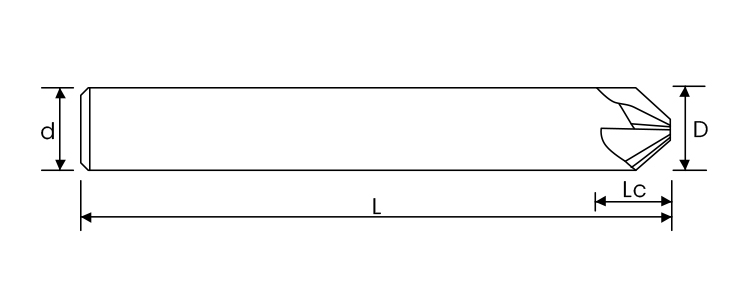
| Model | Shank Dia.(d) | Overal Length(L) | Flutes |
| 4*50*90° | 4 | 50 | 4 |
| 6*50*90° | 6 | 50 | 4 |
| 8*60*90° | 8 | 60 | 4 |
| 10*75*90° | 10 | 75 | 4 |
| 12*75*90° | 12 | 75 | 4 |
| 14*100*90° | 14 | 100 | 4 |
| 16*100*90° | 16 | 100 | 4 |
FAQs:
1. How do operators calculate spindle speeds when running a small tip diameter?
Calculating cutting speed for a pointed bevel tool requires measuring the effective working diameter rather than the full shank size. In addition, programmers set higher spindle RPM because the narrow point travels at much lower surface speed than the outer perimeter. Therefore, machinists run this CNC chamfer mill with adjusted feed tables to prevent edge dragging.
2. Why does a 4-flute design reduce edge chatter compared to 2-flute countersinks?
Spacing four cutting edges around the solid blank keeps at least two flutes engaged in the cut simultaneously. In addition, this continuous tooth contact damps harmonic vibration that typically causes surface scalloping on component corners. As a result, this 4 flute solid carbide chamfer mill delivers mirror-like side finishes without slowing table feed rates.
3. How does the TiSiN nanocomposite coating protect cutting edges in cast iron milling?
Abrasive sand particles and graphite flakes rapidly wear unprotected carbide during dry cast iron machining passes. Fortunately, our silicon-doped TiSiN layer provides surface microhardness up to 3300 HV while acting as a thermal shield. Consequently, this deburring chamfer mill resists abrasive flank wear when breaking sharp edges on rough engine casting blocks.
4. When should machinists choose 60 degree, 90 degree, or 120 degree angle profiles?
Select a 90 degree carbide chamfer mill for standard 45-degree edge breaks and flush-screw countersinks. Alternatively, choose a 60 degree carbide chamfer mill to prepare weld prep grooves or clean deep dovetails. Finally, deploy a 120 degree carbide chamfer mill for gentle 30-degree lead-in chamfers on threaded holes and hydraulic port entries.
5. Can this single cutter execute both hole countersinking and perimeter edge deburring?
CNC programmers readily interchange this tool between spot hole beveling and 2D outer contour profiling. Furthermore, this multi-purpose edge chamfering tool functions as a rigid hole chamfering tool by interpolating helical toolpaths on various bore sizes. As a result, machine shops lower overall tool-changer magazine consumption across complex multi-feature steel components.