
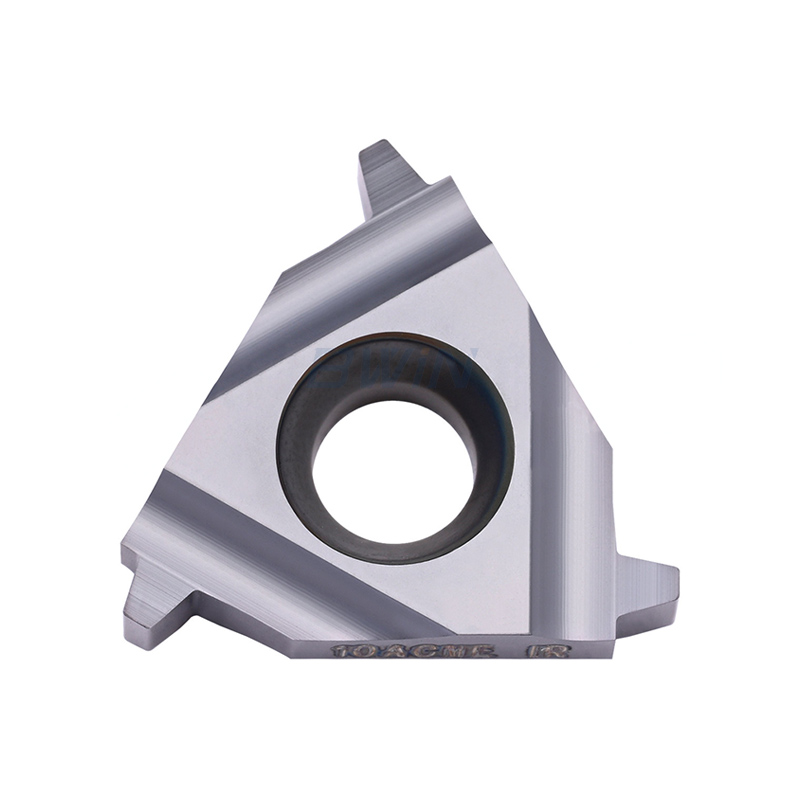


Product Overview:
Product Features:
Applications and Machnining Materials:
29° ACME Thread Insert Specifications:

| Right Hand | D | Pitch | L | X | Y | |
| External | 16ER 14ACME | 3/8 | 14 | 16 | 1.0 | 1.2 |
| 16ER 12ACME | 12 | 1.1 | 1.2 | |||
| 16ER 10ACME | 10 | 1.3 | 1.3 | |||
| 16ER 8ACME | 8 | 1.4 | 1.5 | |||
| 22ER 6ACME | 1/2 | 6 | 22 | 1.8 | 2.1 | |
| 22ER 5ACME | 5 | 2.0 | 2.3 | |||
| 22ER 4ACME | 4 | 2.4 | 2.7 | |||
| Internal | 16IR 14ACME | 3/8 | 14 | 16 | 1.0 | 1.2 |
| 16IR 12ACME | 12 | 1.1 | 1.2 | |||
| 16IR 10ACME | 10 | 1.3 | 1.3 | |||
| 16IR 8ACME | 8 | 1.4 | 1.5 | |||
| 22IR 6ACME | 1/2 | 6 | 22 | 1.8 | 2.1 | |
| 22IR 5ACME | 5 | 2.0 | 2.3 | |||
| 22IR 4ACME | 4 | 2.4 | 2.7 |
Notes: We offer full customization for all specs. For more information, please contact us at any time.
FAQs:
1. Which infeed method prevents chatter during heavy ACME thread turning?
Modified flank infeed at 14.5 degrees significantly reduces tool pressure compared to radial plunge feeding. In addition, angling the slide along one flank forces chips to exit freely without jamming the broad 29-degree nose radius. Consequently, operators eliminate tool deflection when running heavy ACME thread machining cycles on slender machine lead screws.
2. When should CNC machinists select 16ER versus 22ER ACME thread inserts?
Size 16 blanks handle moderate pitches from 16 down to 8 TPI with standard holders. In contrast, heavier pitches like 6, 5, or 4 TPI demand a larger 22ER ACME insert or heavy-duty 22IR ACME insert to absorb deep radial thrust forces. Therefore, programmers match toolholder pocket dimensions directly to target lead screw pitch tables.
3. How do operators select the correct anvil shim for high helix angle screws?
Steep lead screws tilt the threading clearance angle, which causes trailing flank rubbing unless operators install matching tilted anvils. Fortunately, calculating screw lead angle allows machinists to switch shims from standard 1.5 degrees to 2.5 or 3.5 degrees. As a result, this adjustment protects the ACME thread turning clearance profile from catastrophic side wear.
4. Can a single internal ACME insert cut small-diameter blind-hole nuts?
Internal threading bars require adequate bore clearance to prevent the tool heel from gouging the minor thread diameter. Furthermore, choosing a compact 16IR ACME insert mounted on a solid carbide boring bar ensures rigid reach without chatter in long nuts. Therefore, machine shops produce tight internal ACME nuts down to 25 mm.
5. How does Grade BT015 PVD coating improve tool life in stainless steel threading?
Austenitic stainless steels generate severe friction heat that causes premature edge chipping during thread form generation. Fortunately, our Grade BT015 PVD layer creates a tough thermal barrier that prevents work hardening and flank wear on every pass. Consequently, CNC lathe operators prolong carbide threading insert edge life while meeting strict Class 2G thread standards.
Notes: As a matter of fact, Bwin delivers a comprehensive range of high-quality CNC spare parts. To be specific, our catalog covers carbide end mills, carbide inserts, turning bar tools, face milling tools, hole drilling tools, thread tapping tools, carbide burrs, tool holders, machine vises, live centers, chucks, CNC angle heads, carbide saw blades, and clamping kits. What’s more, we also stock brand-name carbide inserts from trusted manufacturers.
Beyond that, we take parts support to the next level. In other words, we don’t just sell components — we actively keep your machines humming and your business moving forward. Above all, every service we deliver aims to minimize your downtime and maximize your output.